 

Career Edge Blog

Introverted

Networking and Job Searching for Introverts

By Jobseeker

Job search can be a daunting task, especially when you’re expected to network as an introvert.

[This comes from Ashvini Sriharan, a project manager at Humber College’s Career & Placement portal!]

The job search process can be an unfair one, giving the more social and outspoken personalities the advantage of confidently reaching out to employers and effectively showcasing their skills. But what about the few of us known to be shy, quiet, or soft-spoken? With the current job searching strategies demanding that we mass network, broadcast our expertise through social media interactions, and out-shine other candidates during the interview process, it’s hard to avoid feelings of low self-worth. We all deserve equal opportunity to access these jobs, but some of us may just need to re-strategize and re-focus our efforts. Here are some tips and resources to help you conquer the job market and how to network as an introvert:

Ashvini Sriharan

Ashvini Sriharan, Humber College project manager

Build your confidence through research

This journey starts with reminding yourself that the negative experiences of job searching and rejection only add to your personal and professional development. If you lose sight of this, it could break your confidence and self-esteem. If you feel your level of confidence is low to begin with, start off by building on how much you know.

Get to know yourself

Understand what your skills are and the values you bring to any organization hiring you. Self-assessment tools which may be available to you for free through your school, help you identify your key personality traits and skills. This also adds words to your vocabulary when answering the “Tell me about yourself” question so you can better describe yourself. When it comes to your professional background, remember that outside of your academic experience, there are other experiences that have contributed to building some of those soft skills necessary for any role, such as communication, teamwork, time management, and problem-solving. Speak to your school’s Career Services team about its self-assessment tools and building the experience on your resume.

LINK: 10 Awesome Free Career Self-assessment Tools 

Get to know the employer and job

Before going in for an interview or networking event, get to know the employers attending and the jobs being offered. Take notes and bring them with you. Use resources such as the company website, job posting, social media, and even the company page on LinkedIn, which highlights recent updates, company life or culture, and company description. This added knowledge gives you the confidence to initiate conversation and ask questions. If you know the name of the hiring manager or employer attending, look for them on LinkedIn and get to know their professional background as well.

LINK: Searching on LinkedIn 

Approach with curiosity

Once you’ve researched the company and job information available to you, write down the questions that come to mind. Why did they recently rebrand? How did they come up with their mission statement? How many accounts would this role manage?

When dealing with face-to-face interactions such as networking events or interviews, approaching the situation with curiosity helps alleviate some of the nervousness. Try to get rid of the goal of making a great first impression – which weakens the authenticity of the interaction – and focus more on actually getting to know the people, the company and the job. Professional relationships should be treated similarly to romantic relationships, in which compatibility, loyalty, and trust are expected from both parties and building long-term value is the main goal. This should ease the pressure off of your effort to network as an introvert.

Create a safe space for yourself

It’s not always to network as an introvert. If social and interview settings increase anxiety, find as many ways as you can to make yourself comfortable. Some examples: wearing your best outfit, introducing yourself on LinkedIn prior to the event, taking a printout of your portfolio to let your work do the talking, going to networking events with a trusted friend, having casual one-on-one informational interviews, or making detailed notes about the person or company to refer to.

When it comes to interviews or public speaking, a personal trick is to throw away the script and the pressure of sticking to it. This requires some confidence and knowledge of the topic you are discussing, as mentioned above. Creating a laid-back and casual space makes you and others comfortable. This will also bring out your true, authentic self, which may be a competitive advantage, helping you stand out from other candidates.

When in doubt, choose online

When you leave a networking event or interview feeling like you didn’t articulate your skills enough, write up a thank-you email reiterating what was discussed along with your qualifications. Attach work samples, resumes, your LinkedIn URL, or testimonials from people you’ve worked with to give the employer the full picture. Thank-you emails are proper networking and interview etiquette and should be sent soon after the interaction.

Professional online portfolios and social networks are key tools to showcase your work and expertise. They also work while you sleep as recruiters and hiring managers skim through LinkedIn profiles to look at the candidate’s online presence. Make sure to sign up for the next online presence or LinkedIn workshop at your campus, as they highlight important tips.

Most importantly, never doubt yourself. Today’s workspaces thrive, with both introverts and extroverts benefitting from having a diverse team. Quiet personalities are not something to be fixed. There are workarounds to help you navigate a job market built for the more outgoing. Accept challenges, get to know yourself, and drop the goal of achieving perfectionism or an ideal self. As author Susan Cain puts it, “We don’t need giant personalities to transform companies. We need leaders who build not their own egos but the institutions they run.” Refocus your networking goals to build long-term relationships and use tools such as LinkedIn to nurture and maintain those relationships. When you navigate the job search process and achieve success, remember to seek out and lend a hand to those who have not yet found their voice in a very loud job market.

CAPE Program – Researcher – Newsroom, CBC Manitoba

By Press Release

CBC is proud to be bringing back the CBC Abilicrew Placements for Excellence (CAPE) program in the Fall of 2019. The abilicrew is an organized group of CBC employees with physical or mental disabilities and their allies. The goal of CAPE is to help launch meaningful careers for those facing barriers to employment by offering networking and development opportunities as well as on-the-job training.

The successful candidates will be immersed in selected departments within CBC which include CBC Local Services, Radio & Audio – Network Talk, Communications, News & Current Affairs, Media Presentation, Digital Products, CBC Music, CBC Sports, and Unscripted Content. The program will run from mid-September to December 2019.

Your role – Researcher – Newsroom

Do you want to be part of the team at CBC Manitoba? We are looking for a bright, energetic, creative researcher who loves a fast-paced environment and knows a great story when they see one. The ideal candidate is web savvy, flexible and a team player.

Who we are:

CBC Manitoba, like all of CBC’s regional centres, believes in the importance of content, community and internal culture. As part of our team, you’d play a key role in focusing on these three priorities outlined in our Local Services strategy:

Content: You will be part of ensuring that our stories are fair, balanced, accurate, and thoughtful, and resonate with the communities we serve. You will help further our original, enterprise and investigative storytelling and ensure we are talking about what matters most to people throughout Winnipeg and the rest of the province. You’re innovative and will try new things, new workflows and new story treatments. You inspire others to do the same.

Community: As the industry shifts, local news and community storytelling is more important than ever. You will understand the diverse and changing population in Manitoba and the importance of reflecting all our communities in our content.

Culture: You live and promote the values of diversity and an inclusive and respectful work culture.

This is what you’ll do:

● Assist reporters and producers with research, chasing guests, cutting tape, following up on story tips.

● Suggest and develop story ideas and program segments

● Support the operation of the newsroom with maintaining file and information databases

● Offered opportunities to perform other journalistic assignments through which you could grow and develop, such as conducting interviews and writing for CBC platforms as needed.

● Work is governed by CBC programming and journalistic policies as well as by established procedures. Advice and guidance are constantly provided under the regular direction of a producer.

This is what you need to bring:

● You are passionate about your community.

● You are connected to diverse communities.

● You’re creative and curious.

● You’re a critical thinker.

● You are collaborative and work well within a team.

● You’re a self-starter.

● You’re able to work under tight deadlines.

● You’re able to multi-task in a fast-paced environment.

● A combination of relevant experience and education equal to a degree and one-year of comparable work experience
● You must self-identify as a person with a disability* to be eligible for this role.

Please include a link to your website, blog or video in your cover letter.

If this sounds interesting, please apply by submitting your resume and cover letter indicating the title of the position that you are applying for to the following email address: cbcplacements@careeredge.ca.

We thank all applicants for their interest, but only candidates selected for an interview will be contacted.

We would ask that if you have accommodation needs at this stage of the application process, to please inform us as soon as possible by sending an email to cbcplacements@careeredge.ca. Please ensure to indicate the position title in the email.

Wherever in the wording of the job description either gender is used, it shall be understood to include all genders.

*The Employment Equity Act identifies and defines persons with disabilities as: a person with a long-term or recurring physical, mental, sensory, psychiatric or learning impairment who consider themselves to be disadvantaged in employment by reason of that impairment or who believe that an employer or potential employer is likely to consider them to be disadvantaged in employment by reason of that impairment, as well as individuals with functional limitations due to their impairment that have been accommodated in their current job or workplace.

Career Edge Case Competition

By News & Announcements

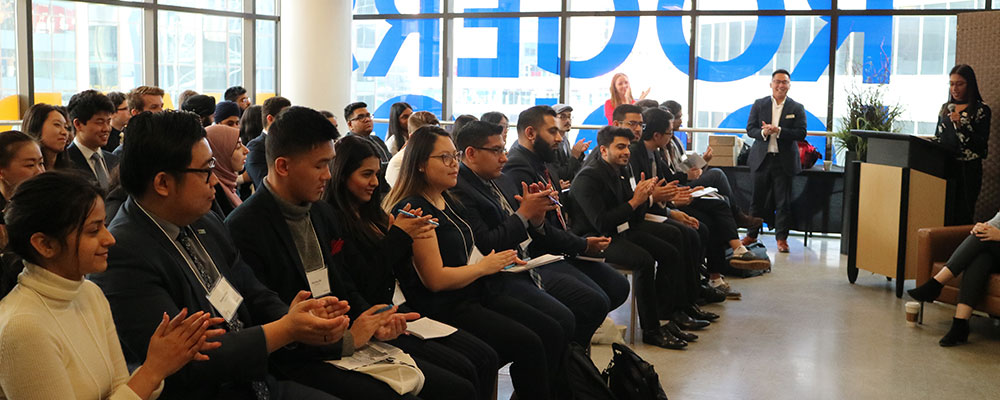
We hosted our first-ever case competition this past Saturday at the Ted Rogers School of Management! With students from Ryerson University, Seneca College, University of Ontario Institute of Technology, University of Toronto Mississauga, University of Toronto Scarborough, Western University, and York University competing for a $3,000 prize pool, we’d like to congratulate again Ameerul Junaidi, Anika Lee, Mujtaba Malik, and Paul Park from University of Toronto Scarborough who won the $1,500 first-place prize.

We’d also like to congratulate Bohan Jiang, Max Verzunov, Jane Wang, and Gary Wu from Western University finishing second and Ryusuke Hijikata, Dimash Mussabetov, Jinxuan Wang, and Yingqi Yan from York University placing third. The team registration proceeds will be donated to the Centre for Addiction and Mental Health.

We’d also like to thank the Ryerson Entertainment Conference, our sponsor EAInfoBiz Inc., our judges Wendy Abbott, Chris Chen, Jenny Ge, Sydney Helland, Pallavi Kodila Srikanth, Valerie Khan, Jennifer Longworth, Carrie Millen, Shelly Mlynarczyk, Natalie Pedrosa, Dr. Vineet Sharma, Sandra Shehadeh, Karen Sihra, Jim Thomson, Sunny Vykunthan, our panelists Carol Alfieri, Dr. Trina Foster, Henry Guerreiro, Vivian Li, Dorena Quinn, and moderator Lien Chia.